


Kia EV6 Charging and Maintenance: What’s Different From a Gas-Powered Kia
Key Takeaways:
- The EV6 eliminates oil changes, spark plugs, transmission fluid, and exhaust system maintenance entirely, resulting in meaningful savings over 100,000 miles compared to a gas Kia
- Tires wear faster on the EV6 than on comparable gas models due to the vehicle’s weight and instant torque delivery, making rotation intervals more important than most owners realize
- Daily charging to 80% rather than 100% is the single most impactful habit for long-term battery health, and it costs nothing to implement
- Battery degradation that’s caught early through periodic health checks typically costs a fraction of what a full pack replacement runs after prolonged neglect
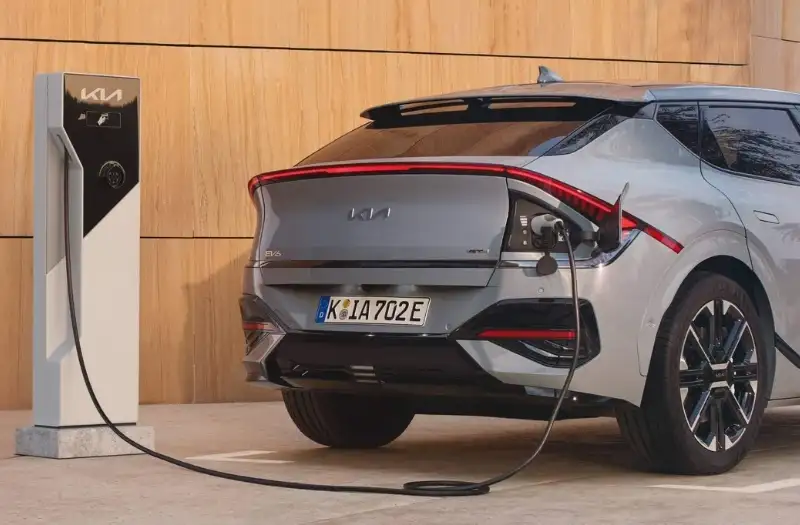
Driving an EV6 for the first time feels noticeably different from any gas-powered Kia, and owning one long term is different in ways that go well beyond how it drives. The maintenance list is shorter, the charging routine replaces the gas station, and a lot of what Sportage or Sorento owners think about regularly simply doesn’t apply. But an EV6 owner who assumes maintenance has nearly disappeared can end up spending $1,500 to $4,000 more than necessary on tire replacements and battery repairs that routine attention would have prevented. Understanding what’s actually changed, and what hasn’t, is the most useful thing a new EV6 owner can do in the first year of ownership.
The EV6 represents one of the more significant ownership transitions available in Kia’s current lineup. Coming from a gas Kia, the immediate differences are obvious: no oil change reminders, no exhaust note, no multi-gear transmission hunting for the right ratio in traffic. What’s less obvious is that the EV6 still has meaningful maintenance needs that are easy to overlook precisely because so much of what used to fill a maintenance schedule has been eliminated. The owners who get the most out of their EV6 over 100,000 miles and beyond are almost always the ones who understood which parts of the ownership equation changed and which parts stayed the same.
What the EV6 No Longer Needs
The list of services that disappear with the transition from a gas Kia to the EV6 is one of the clearest arguments for EV ownership from a pure cost standpoint.
Oil changes are gone entirely. On a gas Sportage or Sorento, oil changes at roughly $80 to $120 each over 100,000 miles add up to $800 to $1,200 in a service that simply doesn’t exist on the EV6. Spark plugs, which come due around 60,000 miles on most gas Kia four-cylinder engines at $150 to $250 for a full set, are another eliminated line item. The EV6’s single-speed reduction gear is a sealed unit that doesn’t require periodic fluid changes under normal operating conditions, which removes another service that catches gas Kia owners off guard at higher mileage. There’s no exhaust system to develop leaks or require catalytic converter attention, and no timing chain to inspect as mileage builds.
The cumulative savings over 100,000 miles compared to a gas Kia are significant and worth understanding clearly:
Gas Kia Sportage maintenance through 100,000 miles:
- Oil changes over 100,000 miles at roughly $100 per visit: $1,000
- Spark plug replacement at 60,000 miles: $150 to $250
- Transmission fluid service at 60,000 miles: $150 to $250
- Coolant flush at 60,000 miles: $100 to $150
- Exhaust and emissions-related maintenance: $100 to $300
- Estimated gas model maintenance total: $1,500 to $1,950
Kia EV6 through 100,000 miles for the same services:
- Oil changes: $0
- Spark plugs: $0
- Transmission fluid: $0
- Engine coolant flush: $0
- Exhaust maintenance: $0
- Estimated EV6 savings on eliminated services: $1,500 to $1,950
What the EV6 Still Needs That Owners Often Miss
The services that remain on the EV6’s maintenance list are the ones most likely to be underestimated, and the ones that create the largest unexpected costs when they fall through the cracks.
Tires are the most important ongoing maintenance item on the EV6, and they deserve more attention than most owners coming from a gas Kia expect. The EV6 is heavier than a comparable gas model due to its battery pack, and its instant torque delivery puts more stress on front tires during acceleration than a gas engine’s more gradual power delivery does. In practice, this means EV6 tires wear faster than those on a comparable gas Kia, and rotation intervals of every 5,000 to 7,500 miles rather than 10,000 miles make a meaningful difference in how evenly wear distributes across all four corners. A set of replacement tires for the EV6 typically runs $700 to $1,000 depending on size and brand, and premature wear from infrequent rotations can cut that lifespan significantly shorter than it should be.
Brakes on the EV6 benefit substantially from regenerative braking, which handles most deceleration without engaging the physical brake pads at all. In practice, EV6 brakes often last 70,000 to 90,000 miles or more before needing pad replacement, which is considerably longer than most gas Kia owners are used to. The trade-off is that rotors on vehicles relying heavily on regenerative braking can develop surface rust from infrequent physical brake use, particularly during Beavercreek’s wetter seasons. Occasional firm brake applications at highway speeds help keep rotor surfaces clean and prevent the surface rust that can cause noise and reduced effectiveness when the physical brakes are eventually needed.
The cabin air filter and battery thermal management coolant are two additional items that deserve attention on a schedule. Cabin air filter replacement runs $30 to $60 and keeps the EV6’s climate system working efficiently, which matters more in an EV where climate control draws directly from the battery. The thermal management coolant, which keeps the battery operating within its optimal temperature range, degrades over time and will need replacement at intervals specified by Kia, typically further out than an engine coolant flush would be due on a gas model but not something to ignore indefinitely.
Priya Nakamura, a service technician at our Beavercreek location, says tire-related concerns are by far the most common unexpected cost she sees with EV6 owners in the first two years. “Most people come from a gas car where they got used to rotating tires every oil change, and on an EV there’s no oil change to anchor that habit. So they go a year and a half without a rotation, and by the time they come in the wear is uneven enough that we’re having a conversation about replacing tires earlier than we should be. The car itself doesn’t remind you the same way an oil change light does. You have to build that habit yourself, and most people don’t realize that until after the first set of tires.” She recommends that EV6 owners set a standalone calendar reminder for tire rotations from day one of ownership rather than waiting for a service visit to prompt it.
Battery Health: The Ownership Variable That Matters Most Long Term
For all the maintenance the EV6 simplifies, the battery is the one component that deserves sustained attention because it’s both the most expensive part of the vehicle and the one most directly shaped by daily habits.
Charging behavior has a direct and measurable impact on how the battery ages over time. Regularly charging to 100% and leaving the battery at full charge for extended periods accelerates cell degradation faster than keeping it in a moderate range. Kia recommends setting the daily charge limit to 80% for routine driving and reserving full charges for longer trips, and that guidance is worth following consistently rather than occasionally. The EV6’s charging interface makes it easy to set a charge limit the car respects automatically, which removes the need to remember manually each time.
Frequent DC fast charging is one of the conveniences that makes EV ownership practical for longer drives, but relying on it as the primary charging method over many years puts more cumulative heat stress on the battery than a mix of home Level 2 charging with occasional fast charging would. The EV6’s 800-volt architecture handles fast charging more efficiently than most EVs, which reduces but doesn’t eliminate the heat load that comes with repeated DC fast charging sessions.
The cost difference between good and poor charging habits over time is significant:
EV6 owner with consistent charging habits and periodic battery checks:
- Annual battery health diagnostic: $0 to $100
- Battery retaining 85 to 90% capacity at 100,000 miles: no intervention needed
- Total battery-related cost through 100,000 miles: $0 to $300
EV6 owner with poor charging habits and no monitoring:
- Battery degraded to 70 to 75% capacity by 80,000 miles: noticeable range loss
- Partial battery module replacement to restore capacity: $1,500 to $3,500
- Full battery pack replacement in severe cases: $9,000 to $15,000
- Total battery cost after poor habits: $1,500 to $15,000 depending on severity
What Beavercreek EV6 Owners Should Keep in Mind
A few habits make EV6 ownership straightforward and cost-effective over the long haul:
- Set a tire rotation reminder every 5,000 to 7,500 miles from day one. Without an oil change visit to anchor it, tire rotation is the most commonly skipped routine service on the EV6 and the one that creates the most unnecessary cost when it falls behind. A standalone calendar reminder takes thirty seconds to set and pays for itself many times over in extended tire life.
- Keep daily charging at 80% and use full charges selectively. This single habit has more long-term impact on battery health than any other maintenance decision an EV6 owner makes, and Kia’s charging interface makes it easy to automate. Treating 80% as the normal daily ceiling and 100% as a road trip setting is the most cost-effective battery habit available.
- Schedule a battery health diagnostic every 30,000 miles. A periodic check of cell voltages and overall pack capacity gives an early picture of how the battery is aging and whether any cells are falling behind before the gap becomes significant enough to affect range. Catching an imbalance early through a module replacement is a fraction of the cost of a full pack replacement after prolonged neglect.
The EV6 is a genuinely low-maintenance vehicle compared to any gas Kia, and the savings in eliminated services over 100,000 miles are real. But low maintenance isn’t the same as no maintenance, and the EV6 owners who get the most out of their vehicle long term are the ones who understood what changed, stayed consistent with what remained, and built good charging habits from the start rather than discovering their importance after the battery had already paid the price.
If you’ve recently made the switch to an EV6 or want to know where your battery and tires stand, stop by and let us take a look. The team at Kia of Beavercreek, located at 2220 Heller Dr, Beavercreek, OH 45434, can check your tire condition, run a battery health diagnostic, and make sure your EV6 is set up to deliver the range and reliability it was built for.
0 comment(s) so far on Kia EV6 Charging and Maintenance: What’s Different From a Gas-Powered Kia