


Kia Timing Chain vs. Belt: Which Engine Is Under Your Hood and What It Means for Service
Key Takeaways
- Not all Kia engines use the same system. Some rely on a timing chain designed to last the life of the engine, while others use a timing belt that requires scheduled replacement.
- A missed belt replacement can be catastrophic. On interference engines, a snapped timing belt can cause the pistons to strike the valves, leading to major internal engine damage.
- Chains aren’t entirely maintenance-free. Timing chains can stretch or wear over tens of thousands of miles and may eventually need attention, particularly involving the tensioner.
- Knowing your engine code matters. The correct interval and service type depend on the specific engine under the hood, not just the model name on the vehicle.
Ask most Kia owners whether their car has a timing belt or a timing chain, and the honest answer is usually a shrug. A routine timing belt replacement runs $500 to $900, while a snapped belt on an interference engine can mean an engine repair bill running into the thousands. That gap in cost, and in consequence, is exactly why knowing which system sits under the hood matters more than most owners realize until it’s too late to matter.
What the Timing System Actually Does
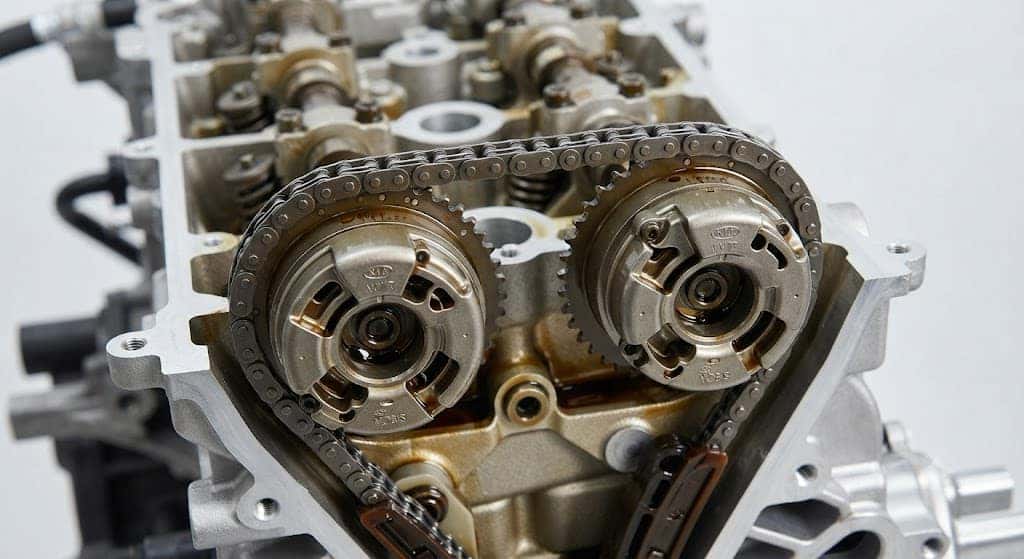
Every internal combustion engine needs the crankshaft and camshaft to stay perfectly synchronized, since that synchronization determines when the valves open and close relative to the position of the pistons. The timing chain or timing belt is the physical link that keeps these two components moving in step with each other. A chain is made of metal links, similar in concept to a bicycle chain, and runs submerged in engine oil where it’s lubricated continuously. A belt is made of reinforced rubber compound, runs dry outside the oil system, and depends on the rubber compound holding up over time and mileage rather than being continuously lubricated the way a chain is.
This distinction is the reason the two systems have such different service philosophies. A timing chain, bathed in oil and made of metal, is often designed to last the life of the engine under normal conditions, which is where the common assumption that Kias never need timing service comes from. A timing belt, made of rubber and running dry, degrades from heat cycling and material fatigue regardless of how well the rest of the engine is maintained, and Kia specifies a hard mileage or time interval for replacement precisely because that degradation is predictable and unavoidable.
Why the Difference Matters More on Some Engines Than Others
Not every engine responds the same way if the timing system fails. On what’s called a non-interference engine, the pistons and valves occupy separate enough space that a broken timing belt or chain simply stops the engine, an inconvenient but relatively inexpensive failure to recover from. On an interference engine, however, the pistons and valves share space at certain points in their travel, relying entirely on correct timing to avoid contact. If the belt snaps or the chain fails on an interference engine, the pistons can strike the open valves directly, bending or breaking them and often damaging the piston heads and cylinder walls in the process.
Several Kia engines used across the lineup, including certain four-cylinder applications common in Beavercreek area vehicles, are interference designs, which is exactly why Kia’s specified belt replacement interval isn’t a suggestion so much as a deadline. Priya Nakamura, one of the technicians in the Kia of Beavercreek service department, has seen the difference in outcomes firsthand between belt-driven engines serviced on schedule and those brought in only after a belt has already failed. The gap between a planned replacement and an unplanned failure on these engines isn’t a matter of degree, it’s the difference between a routine service appointment and a conversation about whether the engine is worth rebuilding at all.
How to Know Which System Your Kia Has
The engine’s timing system isn’t always obvious from the trim level or model year alone, since Kia has used both timing chains and timing belts across different engine families, sometimes even within the same model generation depending on the specific engine option selected. The most reliable way to confirm which system is present is by the engine code, typically found on a placard under the hood or in the vehicle’s documentation, cross-referenced against Kia’s specifications for that engine family. Guessing based on general assumptions about “modern engines” or “smaller engines” isn’t reliable enough to base a maintenance decision on, particularly given how much is at stake if the vehicle turns out to be a belt-driven interference engine well past its service interval.
What a Timing Service Actually Involves
- Timing belt replacement (belt-equipped engines). The belt itself is replaced at the manufacturer-specified interval, along with the tensioner and idler pulleys in most cases, since these components wear alongside the belt and are far cheaper to replace proactively than to have fail shortly after a new belt is installed.
- Water pump replacement alongside the belt. On many Kia engines, the water pump is driven by the timing belt and sits in a location that requires most of the same disassembly, making it a strong candidate for replacement at the same time rather than paying for that labor twice.
- Timing chain inspection and tensioner check. On chain-equipped engines, technicians check for chain stretch, unusual noise from the timing cover area, and tensioner function, since a worn tensioner can allow chain slap or, in more advanced cases, allow the chain to skip a tooth on the sprocket.
- Timing cover seal and gasket check. Both systems involve a timing cover that can develop oil leaks over time, and checking these seals during a timing service prevents a separate leak-related repair down the line.
Cost Breakdown for Timing Service in Beavercreek
- Timing belt replacement only: Typically runs $500 to $700 depending on the specific engine and labor time required to access the belt.
- Timing belt replacement with water pump: Usually falls between $700 to $900 when done together, which is generally the recommended approach given the shared labor involved.
- Timing chain tensioner or guide replacement: Generally runs $400 to $650 depending on how much of the front engine cover needs to come off to access the affected components.
- Deferred cost (interference engine damage from a failed belt): Engine repair or replacement following a snapped timing belt on an interference engine can run into the thousands, several times the cost of the scheduled service that would have prevented it.
Recognizing Early Warning Signs
Tyrell Banks, another technician who has worked across several Kia locations including Beavercreek, notes that timing chain issues tend to announce themselves through sound before they become a serious mechanical problem. A rattling or clicking noise from the front of the engine, particularly noticeable at startup before oil pressure builds fully, is a common early sign of chain stretch or a failing tensioner. “That startup rattle gets written off as normal engine noise more often than it should be, and by the time it’s constant instead of just at startup, the chain has usually stretched more than we’d like to see,” Banks has noted about the pattern seen in vehicles coming in for this concern. Timing belts, by contrast, rarely give an audible warning before failure, which is exactly why the mileage interval matters more than symptom-watching for belt-equipped engines.
Setting the Right Schedule for Your Specific Engine
For Kia owners in the Beavercreek area, confirming the timing system on a specific vehicle is a worthwhile first step before assuming either “it’s a chain, so I don’t need to worry about it” or “it’s probably fine a little past the interval.” Belt replacement intervals from Kia typically fall somewhere in the range of 60,000 to 100,000 miles depending on the engine, and that number is worth confirming precisely rather than estimating, given how much more expensive a missed interval can become on an interference design.
If you’re not sure whether your Kia has a timing belt or a timing chain, or if you’ve noticed any unusual noise from the front of the engine, the team at Kia of Beavercreek, located at 2220 Heller Dr, Beavercreek, OH 45434, can confirm your engine’s timing system and get you on the correct service schedule before a routine interval turns into an unplanned repair.
0 comment(s) so far on Kia Timing Chain vs. Belt: Which Engine Is Under Your Hood and What It Means for Service