


EV Spring Maintenance Tips for the Kia EV6
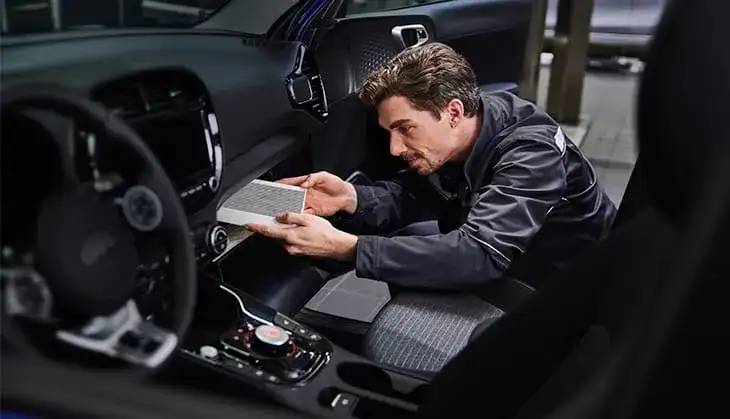
Last month, a Kia EV6 came in from Fairborn after its owner had noticed his displayed range had not recovered to expected levels even as March temperatures climbed into the 50s. He had dismissed the issue through winter as normal cold-weather range reduction and never scheduled a service appointment since taking delivery fourteen months earlier. When our technician completed the inspection, all four tires were significantly underinflated from months of Ohio temperature cycling, the cabin air filter was completely blocked after a full Greene County winter and spring pollen season, and the brake rotors showed meaningful surface corrosion from fourteen months of regenerative-dominant braking with minimal friction brake use. The spring service that would have addressed all three items incrementally across the ownership period? $210. The catch-up service required to address everything simultaneously? $480.
That fourteen-month gap between delivery and first service appointment is the most consistent pattern we see with first-year EV6 owners at Kia of Beavercreek. It almost always traces back to the same assumption: that an electric vehicle with no oil changes and no spark plugs requires essentially no maintenance attention. The assumption is understandable and it is also expensive, because the service items that remain on the EV6’s schedule are ones that Ohio’s specific driving conditions affect meaningfully, and deferring them compounds in ways that cost more than the individual services would have.
The EV6 is genuinely well suited for Greater Dayton and Greene County driving. Its instant torque delivery handles the grades and highway merges on I-675 and US-35 with ease, and its range is adequate for the vast majority of daily driving patterns in the Beavercreek and Fairborn area. But well suited for the road and properly maintained for the road are two different things, and understanding what Ohio winter specifically does to an EV6 sets the foundation for a spring service plan that protects the investment from here forward.
This guide covers the complete EV6 spring maintenance picture for Beavercreek-area owners, what a Greene County winter does to each relevant system, and how to build a first-spring service plan that keeps your EV6 performing the way it was engineered to.
What Changes About Maintenance When You Drive an EV6
The EV6 eliminates a significant list of conventional maintenance items that defined previous Kia ownership for most drivers. There are no oil changes, no spark plugs, no transmission fluid service, no timing belt, and no exhaust system components on the EV6’s maintenance calendar. Over a five-year ownership period, that elimination represents genuine and meaningful savings compared to a comparable Sportage or Telluride.
But the EV6 is not a maintenance-free vehicle. It’s a differently maintained vehicle, and several of the items that remain are ones that Ohio’s climate and driving conditions affect in specific ways that Beavercreek-area owners need to understand before the first service interval arrives unannounced.
Regenerative Braking and What It Does to Your Rotors
The EV6’s regenerative braking system handles the majority of deceleration during normal driving across Beavercreek and the surrounding area, recovering kinetic energy as electrical charge rather than dissipating it as heat through the friction brakes. On the highway segments of I-675, the approach grades on US-35, and the frequent stop-and-go on Dayton-Yellow Springs Road, regenerative braking is doing most of the work that friction brakes would perform on a conventional vehicle.
The long-term benefit is meaningful. EV6 brake pad life extends well beyond what a Sportage or Sorento owner would expect, because the pads simply aren’t used as aggressively or as frequently. The complication is that reduced friction brake use also means the rotors don’t self-clean through regular pad contact the way a conventional vehicle’s rotors do each morning.
Surface corrosion that a Telluride clears through its first few brake applications can accumulate persistently on an EV6 that relies primarily on regen for deceleration. An Ohio winter amplifies this considerably. Road salt exposure, overnight moisture, and weeks of near-exclusive regenerative braking through December, January, and February in Beavercreek create conditions where rotor surface corrosion develops into measurable irregularity without the driver ever feeling a clear warning through the pedal.
This is the specific reason that the annual brake inspection matters more on the EV6 than on any conventional Kia, not less. The system that extends pad life also reduces the feedback mechanism that would normally alert a driver that rotor condition deserves attention. 🔧
Tire Wear and the EV6’s Weight Distribution
The EV6’s battery pack sits in the floor of the vehicle, creating a low center of gravity that contributes to its handling balance but also adds significant weight compared to a conventional vehicle of similar size. That additional weight, approximately 400 to 500 pounds more than a comparable ICE Kia, increases the load on all four tires and accelerates wear relative to what EV6 owners with prior Kia experience might expect from a vehicle this size.
The rear-biased torque delivery of the EV6 RWD model and the AWD variant’s torque distribution characteristics create wear patterns that differ between front and rear tires, with rear wear typically progressing faster under normal driving conditions. Kia recommends tire rotation every 7,500 miles on the EV6, which is more frequent than many conventional vehicles specifically because of the combination of additional vehicle weight and the torque delivery pattern that electric motors produce from a standing start.
Missing even one rotation interval on an EV6 creates a wear differential between axles that becomes difficult and expensive to recover from, because the tires that have worn faster cannot simply be rotated into a balanced position once the differential exceeds a certain threshold.
What a Greene County Winter Does to Your EV6
Ohio EV owners face winter range reduction that is more pronounced than what EV6 owners in moderate climates experience, and the specific geography and driving patterns of Beavercreek and the surrounding area add considerations that flat-terrain, mild-climate EV ownership simply doesn’t encounter.
The EV6’s EPA range estimate is produced at moderate temperatures. Cold weather affects usable range through two simultaneous mechanisms. The battery thermal management system draws power continuously to keep the battery pack within its optimal operating temperature range, consuming charge that would otherwise extend driving range. The cabin heating system draws from the battery directly rather than from waste engine heat as it would in a conventional vehicle, adding a substantial additional draw that doesn’t exist during warmer months.
In genuine Beavercreek winter conditions, where overnight temperatures drop into single digits through January and February and morning commutes begin on a battery that has been cold-soaked in a driveway on Dayton-Yellow Springs Road or Trebein Road, real-world range can be 25 to 35 percent lower than the EPA figure. For an EV6 owner planning a winter drive to Columbus on I-70 or up to Dayton for an evening event, understanding that the comfortable range buffer present in July is compressed in January is practical planning knowledge rather than a concern about the vehicle’s capability.
Charging Habits That Affect Battery Health Through an Ohio Winter
The way Beavercreek EV6 owners charge their vehicles through winter has a direct bearing on battery health that extends beyond the cold season. Kia recommends keeping the EV6’s daily charge level between 20 and 80 percent state of charge for routine use, reserving charges to 100 percent for longer trips where the full range is needed.
Charging to 100 percent regularly accelerates the electrochemical aging process in lithium-ion battery cells, and cold temperatures amplify this effect during the winter months when the battery management system is working hardest to maintain cell temperature. An EV6 that is charged to 100 percent every night through a Beavercreek winter on a Level 2 home charger is accumulating battery stress at a faster rate than one maintained between 20 and 80 percent on the same charger.
Setting the charge limit in the EV6’s charging menu to 80 percent for daily use takes about 30 seconds and costs nothing. The long-term battery health benefit is measurable over a multi-year ownership period.
A Kia EV6 owner from Xenia came in last February after his range estimate had declined noticeably from what he had seen in his first summer of ownership. He had been charging to 100 percent nightly since delivery and had completed several DC fast charging sessions on road trips to Columbus and Cincinnati. After a battery diagnostic, a conversation about charging habits, and an adjustment of his daily charge ceiling to 80 percent, his range estimates stabilized over the following two months. No parts, no repair cost. The right information at the right time prevented a warranty claim conversation that the battery’s actual health didn’t warrant.
Warning Signs Your EV6 Needs Spring Attention
Electric vehicles communicate system condition differently than conventional ones, and recognizing the specific signals that the EV6 produces prevents the easy assumption that a smooth, quiet EV is a problem-free one.
A range reduction that doesn’t recover as spring temperatures arrive in March and April points to a battery health concern, a tire pressure issue, or a combination of factors that a diagnostic visit will identify and separate. Seasonal range variation from cold weather is expected and normal. Persistent range reduction that outlasts the cold season is not.
A change in brake pedal feel, specifically a pedal that feels less progressive than it did at delivery or requires more travel before the brakes engage, warrants a brake inspection given the reduced self-cleaning effect that regenerative-dominant braking creates on rotor surfaces through an Ohio winter.
Uneven tire wear on the rear axle relative to the fronts, visible when crouching at eye level with each tire and comparing wear across the tread width, indicates the rotation interval has been missed and the wear differential needs professional assessment before it crosses into premature replacement territory.
A pulling sensation or tracking inconsistency on flat, straight stretches of I-675 or US-35 points to a tire pressure imbalance or an alignment issue that is wearing your tires unevenly with every mile between now and when it’s addressed.
Any warning related to the high-voltage system, the battery management system, or the drive motor should be treated as a same-week appointment rather than a monitor-and-wait situation. These systems generate warnings deliberately and conservatively on the EV6, meaning an active warning represents a condition that has already developed past its earliest stage. 🔧
Reduced DC fast charge acceptance rate at charging stations that previously delivered full power can indicate a battery thermal management concern or a charging system issue that a diagnostic scan will clarify.
The Spring EV6 Service Cost Picture for Greene County Owners
Deferred spring service approach after one Ohio winter:
- Two rear tires from missed rotation interval creating unrecoverable wear differential: $440 to $580
- Brake rotor service after winter corrosion accumulation from regen-dominant braking: $220 to $360
- Cabin air filter replacement after full winter and spring pollen loading: $55
- Total deferred cost: $715 to $995
Proactive spring EV6 service:
- Tire rotation at 7,500-mile interval: $60 to $80
- Brake inspection with rotor assessment: complimentary with service appointment
- Brake rotor service if corrosion warrants: $190 to $260
- Cabin air filter replacement: $55
- Battery health check and tire pressure calibration: included with service
- Smart proactive total: $305 to $395
Your savings from a proactive spring appointment: $410 to $600. Those figures reflect what our service team at the Heller Drive location sees on actual EV6 service records each spring across Greene County ownership conditions.
“The EV6 owners who have the smoothest long-term experience are consistently the ones who understand from the beginning that electric maintenance is different, not absent,” says Angela Booker, EV Service Specialist at the Heller Drive location. “Tire rotation every 7,500 miles and an annual brake inspection are the two items that matter most for Ohio EV6 ownership specifically. Miss two rotations and you’re replacing rear tires ahead of schedule. Skip the brake check and a winter of regen-only braking has done things to your rotors that you won’t know about until it’s a more expensive conversation.”
Your 30-Day EV6 Spring Maintenance Plan
This week: Check all four tire pressures before your first drive of the morning using a quality gauge and compare to the specification on your driver’s door jamb placard. Ohio’s winter temperature swings drop tire pressure approximately one PSI for every 10-degree temperature decrease, meaning tires set correctly in October can be eight or more PSI underinflated by a February morning in Beavercreek. Underinflated tires on an EV6 affect both displayed range and the rear tire wear pattern that the vehicle’s torque delivery already accelerates. Two minutes with a gauge is the highest return-on-time maintenance action available this week.
Within two weeks: Open the Kia Connect app and review your battery health summary and any stored service reminders. Confirm your daily charge limit is set to 80 percent for routine Beavercreek commuting and check your energy consumption data to establish a spring baseline range expectation now that temperatures are moderating. If your range estimates remain significantly below the EPA figure as April arrives and tire pressure has been confirmed correct, document the specific numbers and bring that information to your service appointment for context.
By month’s end: Schedule your spring EV6 service at the Heller Drive location and ask specifically for the EV spring inspection that covers tire rotation, brake system assessment, cabin air filter evaluation, battery health check, and charging system confirmation. Our Kia-certified EV technicians will give you a complete picture of how your EV6 came through its first or second Ohio winter and what the maintenance calendar looks like through the rest of the ownership year. Bundling all spring items into a single appointment keeps your service record current and your time investment minimal.
These three steps take less than an hour of your actual time across the month and establish the maintenance foundation that separates a genuinely satisfying long-term EV6 experience from one that produces avoidable surprises on the roads of Greene County.
The Kia EV6 is an excellent fit for Beavercreek and Greater Dayton driving when it’s maintained with the conditions it actually operates in. Ohio’s climate and driving patterns create a specific service picture for EV ownership that differs from the national average, and understanding that picture from the first spring of ownership sets the tone for everything that follows.
Schedule Your EV6 Spring Service Today
The Fairborn EV6 owner from the opening came back the following October with his tire rotation on a confirmed 7,500-mile schedule, his charge habits adjusted to an 80 percent daily ceiling, and a spring inspection already on his calendar for the following April. His brake rotors were clean on assessment, his rear tires showed even wear across both corners, and his range estimates were consistent with seasonal expectations. No surprises, no unplanned expenses, no avoidable repair bills driven by a first-year assumption that EVs take care of themselves.
At Kia of Beavercreek, our EV-trained technicians service the EV6 with the model-specific knowledge, diagnostic equipment, and Kia-approved procedures that electric vehicle ownership in Ohio requires. Whether you took delivery last fall and are approaching your first spring service or have been driving your EV6 for over a year without a dedicated inspection, we’ll meet you where you are and build a maintenance plan that protects your investment across every Greene County season ahead.
Schedule your EV6 spring service today by contacting our service department or booking online. You’ll find us at 2220 Heller Dr, Beavercreek, OH 45434.
Proper EV maintenance protects your battery investment, preserves the brake and tire performance your EV6 depends on for Ohio driving, and ensures the efficiency and range that made the vehicle worth choosing remain consistent across every mile of Greater Dayton road ahead. That is what informed electric vehicle ownership looks like in Beavercreek.
0 comment(s) so far on EV Spring Maintenance Tips for the Kia EV6