



 Telluride Hybrid
Kia EV & Hybrid Tire Care: Why the instant torque of the EV6 or Niro requires specialized tires with stronger sidewalls.
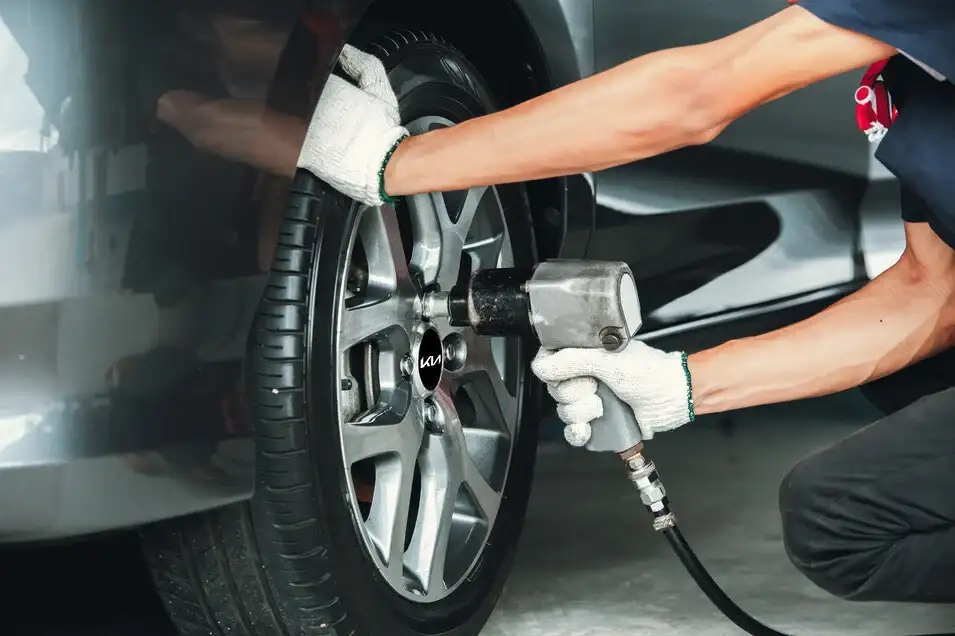
Last fall, a 2023 Kia EV6 came into our service department on Heller Drive at 22,000 miles with front tire wear that would have been unremarkable on a 60,000-mile gasoline vehicle. The owner had replaced the original equipment tires at 18,000 miles with a set of standard all-season tires from a general tire shop, selected by load rating and size without accounting for EV-specific construction requirements. The replacement set had worn through the inner edges aggressively in under four months of Beavercreek commuting. A proper set of EV-rated replacement tires runs $900 to $1,200 for the EV6. The standard all-seasons that failed in four months cost $680.
The Kia EV6 and Niro EV deliver their power in a way that feels nothing like a gasoline engine, and that difference is not just a driving experience observation. It is a tire engineering challenge that catches owners off guard at replacement time because the tires look like normal tires, the size numbers match, and the price of standard alternatives is tempting. The consequences of that substitution show up in accelerated wear patterns, handling changes, and in some cases structural concerns that develop faster than the mileage on the odometer suggests they should.
Beavercreek and the broader Miami Valley area create a specific set of demands on EV and hybrid tires that compound the underlying engineering challenge. The I-675 corridor, the stop-and-go patterns around the Fairborn and Beavercreek commercial areas, and Ohio’s seasonal temperature swings all interact with the unique load and torque characteristics of Kia’s electric drivetrain in ways that make tire selection and maintenance more consequential than it is on a comparable gasoline vehicle. An EV6 owner who treats tire replacement as an interchangeable commodity decision will spend more money over the vehicle’s first 100,000 miles than one who understands what makes EV-specific tires worth the premium.
This guide covers what makes instant torque delivery categorically different for tires than conventional power, what the EV-specific tire construction differences actually are, how to recognize when your EV or hybrid tires need attention, and what the right replacement decision looks like for a Miami Valley Kia EV owner.
Why Instant Torque Changes Everything for Tires
The Physics of Electric Power Delivery
A gasoline engine builds torque progressively as RPM climbs from idle. Even a performance gasoline vehicle delivers its peak torque after a brief ramp-up period that gives tires a fraction of a second to manage the transition from static to dynamic load. An electric motor delivers its maximum torque instantaneously from a complete stop, with no ramp-up period and no mechanical intermediary between the motor’s output and the contact patch where the tire meets the road.
For the EV6’s rear-wheel-drive and dual-motor configurations, this means the tire’s contact patch experiences the vehicle’s full torque load the moment the accelerator is applied from rest, not after a progressive buildup. On a dry surface at moderate acceleration, this feels like effortless, linear thrust. At the tire’s contact patch, it means the rubber compound and internal structure are managing a stress event that is more intense and more abrupt than anything a comparably powered gasoline vehicle produces. Over tens of thousands of acceleration cycles on the I-675 corridor and through the Fairborn and Beavercreek commercial corridors, that difference accumulates into measurably faster wear than the same tire would experience behind a gasoline powertrain.
What EV-Specific Tire Construction Actually Means
Tire manufacturers have developed EV-specific constructions in response to these demands, and the differences go beyond marketing language. The load index on an EV-rated tire is higher than a standard tire of the same size because electric vehicles carry the additional weight of the battery pack, which on the EV6 adds several hundred pounds compared to a gasoline equivalent. Running a standard tire at or near its maximum load rating continuously is different from running an EV-rated tire at a comfortable margin below its rated capacity, and that margin affects wear rate, heat buildup, and structural integrity over time.
The sidewall construction in EV-rated tires uses reinforced materials that handle the lateral stress of instant torque application with less deformation than standard sidewall construction. Sidewall deformation under torque load is one of the primary mechanisms through which standard tires develop accelerated inner edge wear on EV applications, and it is the failure mode that produced the wear pattern on the EV6 in the opening story. The reinforced sidewall maintains the tire’s geometry more precisely through the torque event, distributing the load across the full contact patch rather than allowing the inner edge to carry a disproportionate share.
Noise reduction is a third EV-specific construction consideration that affects Niro and EV6 owners differently than gasoline vehicle owners. Electric drivetrains eliminate the engine noise that masks road and tire noise in gasoline vehicles, making tire roar and road noise significantly more apparent in the cabin. EV-specific tires use foam acoustic dampening layers and optimized tread patterns that reduce rolling noise in ways that matter more in an EV cabin than they would in a gasoline vehicle where engine noise provides constant background masking.
A Niro EV owner from Fairborn came to us last summer after noticing a significant increase in road noise on her commute along US-35 that had developed gradually over about three months. She had replaced her original equipment tires at 28,000 miles with a well-regarded standard all-season tire in the correct size. The noise increase was directly attributable to the absence of the acoustic dampening layer present in the original EV-spec tires. Returning to an EV-rated replacement at her next change resolved the noise level completely.
What Beavercreek Driving Does to EV and Hybrid Tires
Ohio’s Temperature Swings and EV Tire Behavior
The Miami Valley’s seasonal temperature range creates tire management considerations for EV and hybrid owners that gasoline vehicle owners in the same area do not encounter to the same degree. Cold temperatures affect battery range in the EV6 and Niro, which most owners are aware of, but cold temperatures also affect tire pressure more significantly on EV-specific tires than on standard tires because the higher load ratings and reinforced construction make these tires more sensitive to pressure variance relative to their rated capacity.
A one-degree Fahrenheit drop in ambient temperature causes approximately one PSI of pressure loss in a typical tire. For a Beavercreek EV6 owner, the temperature drop from a September afternoon to a January morning represents a pressure loss that, if not corrected, moves the tire meaningfully away from its optimal operating pressure. On a standard tire this produces minor fuel economy and handling effects. On an EV-rated tire carrying the additional weight of the battery pack and managing instant torque delivery, operating at reduced pressure accelerates the inner edge wear pattern that is already the primary wear failure mode for these tires.
Monthly pressure checks during Ohio’s shoulder seasons, specifically October through November and March through April when temperatures fluctuate most dramatically, are a straightforward habit that meaningfully extends EV tire service life in the Miami Valley climate. The correct inflation pressure for the EV6 and Niro EV is on the door placard and is often higher than owners expect, reflecting the load requirements of the battery weight rather than the ride comfort optimization that governs inflation recommendations on lighter gasoline vehicles.
Rotation Intervals That Actually Match EV Wear Rates
The standard tire rotation interval recommendation of 5,000 to 7,500 miles was developed around gasoline vehicle wear patterns and does not account for the accelerated front or rear wear that electric drivetrains produce depending on their configuration. The EV6’s rear-wheel-drive base configuration concentrates torque delivery at the rear axle, producing rear-dominant wear that requires more frequent rotation than the standard interval to keep all four tires wearing evenly. The dual-motor all-wheel-drive configuration distributes torque across all four corners but still produces wear patterns that differ from a gasoline AWD vehicle due to the instant torque characteristic.
For Beavercreek EV6 and Niro owners, a rotation interval of 5,000 miles rather than the standard 7,500 is the appropriate target given Miami Valley stop-and-go driving patterns and the torque characteristics of the electric drivetrain. At $50 to $65 per rotation, the additional annual rotation cost is modest relative to the tire set cost it protects, and the wear documentation it provides gives an accurate picture of tire progression that allows replacement timing to be planned rather than forced by unexpected wear.
What running non-EV tires on an EV costs:
- Standard all-season set that wears prematurely in 12,000 to 18,000 miles: $680 – $900
- Second replacement set required sooner than expected: $680 – $900
- Alignment correction from wear-induced handling changes: $120 – $160
- Total over 36,000 miles with wrong tires: $1,480 – $1,960
What EV-rated tires with proper maintenance costs:
- EV-rated replacement set: $900 – $1,200
- Four rotations at correct EV interval over same mileage: $200 – $260
- Smart total over 36,000 miles: $1,100 – $1,460
Your potential savings from the right tires and intervals: $380 – $500.
Warning Signs Your EV or Hybrid Tires Need Attention
Recognizing developing tire issues on an EV or hybrid requires paying attention to indicators that differ somewhat from gasoline vehicle tire wear signals. The weight distribution, torque characteristics, and noise environment of the EV6 and Niro mean that some standard tire warning indicators arrive differently or later than owners accustomed to gasoline vehicles expect.
- Inner edge wear significantly ahead of center tread wear. Run your hand across the tire from the inner edge to the outer edge. A noticeable step or ridge at the inner edge indicates the torque-related wear pattern that EV-rated sidewall construction is designed to prevent.
- Increased road noise that develops gradually rather than suddenly. In the quiet cabin of an EV6 or Niro, gradual noise increases are more detectable than in a gasoline vehicle. Noise that was not present at purchase and has grown over several thousand miles warrants a tread and sidewall inspection.
- Handling that feels less planted on I-675 on-ramps than it did when new. A reduction in the confident, planted feel during the instant torque application of highway entry acceleration is an early indicator of sidewall integrity changes.
- Pressure loss that is faster than expected between monthly checks. Faster-than-expected pressure loss in an EV tire, beyond what temperature change accounts for, indicates a slow leak or valve stem issue worth addressing before it progresses to a flat under load.
- Visible sidewall cracking or stress marks near the rim flange. The higher load demands on EV tires make sidewall inspection more important than on standard tires. Any cracking near the rim flange warrants immediate professional evaluation.
- Vibration at highway speeds that was not present previously. Post-torque-stress vibration that develops gradually often indicates internal structural changes in a tire that has been running beyond its appropriate load or pressure specifications.
_”The conversation I have most often with EV6 and Niro owners is about why their tires wore out faster than expected, and almost every time the answer is the same two things: the wrong replacement tire and not enough rotations,” says Marcus Webb, EV Service Specialist at the Heller Drive location. “EV tires are an area where the upfront cost difference between doing it right and doing it cheap is smaller than the total cost difference over the life of the vehicle. We walk every EV owner through the specific requirements for their configuration before they leave with a replacement recommendation.”*
Your 30-Day EV Tire Health Check
This week: Check tire pressure across all four corners and compare to the door placard specification. Do this in the morning before the vehicle has been driven, when the tires are cold and the reading reflects the true static pressure rather than heat-expanded pressure from driving. Note whether any tire is more than three PSI below the placard spec and whether any tire is losing pressure faster than the others between checks. The EV6 and Niro’s higher recommended pressures mean that the same ambient temperature drop that causes a one to two PSI loss on a standard tire may cause a slightly larger variance on an EV-rated tire operating near its load capacity with battery weight.
Within two weeks: Perform a hands-on tread wear inspection across all four tires. Run your palm firmly from the inner edge to the outer edge of each tire’s contact surface. On a rear-wheel-drive EV6, pay particular attention to the rear tires where torque delivery is concentrated. On the dual-motor configuration, check all four corners for the inner edge wear pattern that indicates the torque-related sidewall stress that EV-rated construction is designed to manage. Note the tread depth at the inner, center, and outer positions on each tire independently, since EV wear patterns frequently produce uneven depth across the width that center-only tread depth checks miss entirely.
By month’s end: Schedule an EV tire consultation and rotation at Kia of Beavercreek. If your EV6 or Niro is approaching or past 20,000 miles without a documented rotation, or if you are unsure whether your current tires are EV-rated for your specific configuration, bring it in for an EV tire evaluation before the wear pattern progresses further. Our technicians will measure tread depth across the full width of each tire, verify that your current tires meet the load and construction requirements for your drivetrain configuration, and advise on rotation interval and replacement timing based on your actual wear progression rather than a generic mileage estimate.
These three steps take less than forty-five minutes of your time but establish the maintenance foundation that keeps an EV6 or Niro’s tire costs predictable rather than reactive over the vehicle’s first 100,000 miles in the Miami Valley.
The Right Tires Make the EV Experience What It Should Be
The EV6 owner from the opening came back to us after that four-month wear failure and replaced the standard all-seasons with an EV-rated set appropriate for his rear-wheel-drive configuration. At 19,000 miles on that set, his wear is progressing evenly across the contact patch with no inner edge acceleration, his road noise level matches what he remembers from the original equipment tires, and he is on a 5,000-mile rotation schedule that his service records document consistently. The total cost of his correct tire set and four rotations has already come in below what the failed standard all-season set cost him in four months.
The EV6 and Niro are genuinely exceptional vehicles in the Miami Valley driving environment, and their tire requirements are a straightforward extension of what makes them exceptional. Instant torque, battery weight, and a quiet cabin all have tire implications that are manageable when addressed correctly and expensive when they are not.
When you are ready to evaluate your EV or hybrid tire situation, the service team at Kia of Beavercreek, located at 2220 Heller Dr, Beavercreek, OH 45434, has the EV-specific expertise to assess your current tires, recommend the correct replacement specification for your configuration, and establish a rotation interval that matches your drivetrain’s actual wear characteristics. Scheduling is available online or through the service department. The right tires on a Kia EV are not an upgrade. They are a requirement, and the difference shows up in every mile you drive. 🔋

0 comment(s) so far on Kia EV & Hybrid Tire Care: Why the instant torque of the EV6 or Niro requires specialized tires with stronger sidewalls.